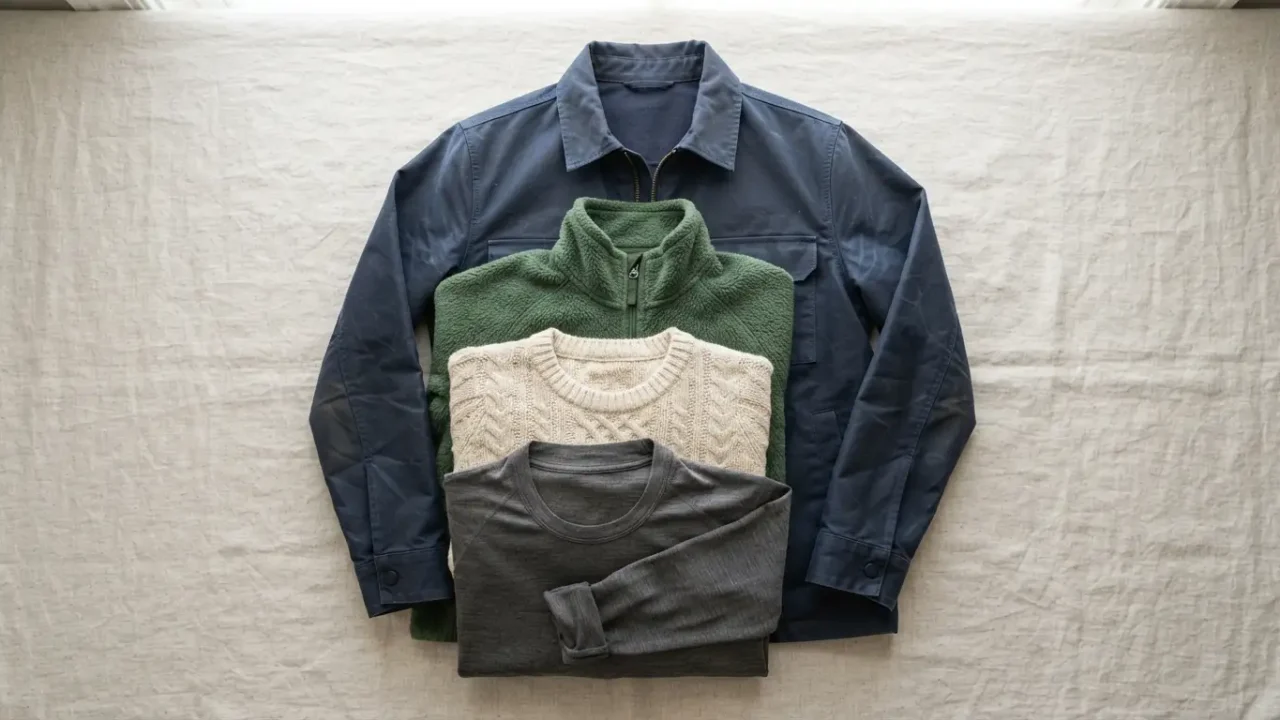
Most people build an outerwear wardrobe the way they build a junk drawer: one coat bought for a cold snap, one jacket for a trip, and something else that seemed like a good idea at the time. The result is a closet full of pieces that don’t quite work together and still leaves you cold on the days that matter. A better approach is to think in layers. When each piece has a clear job, a small number of items can cover almost every kind of weather you’ll face.
In this guide
- The Idea Behind Layering
- The Base Layer: Where Comfort Starts
- The Mid Layer: Your Warmth Engine
- The Outer Layer: Your Shield Against Weather
- The Core Pieces Worth Owning
- Choosing Fabrics That Work Together
- Getting the Fit Right Across Layers
- Adapting Your Wardrobe to Your Climate
- Common Layering Mistakes to Avoid
- Final Thoughts
The Idea Behind Layering
Layering works because air trapped between thin layers insulates you, and because you can add or remove a piece as conditions change. One thick coat is a fixed amount of warmth. Three well-chosen layers give you a dial you can turn up or down, which matters on days that start freezing and end up mild, or when you move between a cold street and an overheated train.
The system is simple. A base layer sits against your skin and manages moisture, a mid layer holds in warmth, and an outer layer protects you from wind and rain. Everything in your outerwear wardrobe should fit into one of those three roles.
The Base Layer: Where Comfort Starts
The base layer is the one people most often get wrong, because it’s hidden under everything else. Its main job is to move sweat away from your skin so you don’t end up damp and chilled. Cotton is a poor choice for this, since it holds moisture and stays wet. Merino wool and synthetic blends handle moisture far better, and thin versions add very little bulk.
A few well-fitting long-sleeve base layers in neutral colors are enough for most people. Fit matters here: a base layer should sit close to the body without feeling tight, since a loose one bunches up and defeats the purpose.
The Mid Layer: Your Warmth Engine
The mid layer is where most of your insulation comes from. Fleece, wool sweaters, and lightweight insulated vests are the usual choices, and each suits a slightly different situation. Fleece is warm for its weight and dries quickly. A wool sweater is warm, breathable, and looks good on its own if you take your coat off indoors. An insulated vest keeps your core warm without adding sleeve bulk, which helps if you’re worried about layering getting restrictive.
It’s worth owning a couple of mid layers in different weights. A thin one for mild days and a thicker one for deep cold means you aren’t forced to choose between freezing and overheating. If you’re curious how different insulation types compare, our breakdown of wool vs down vs synthetic coat fill goes into the details.
The Outer Layer: Your Shield Against Weather
The outer layer’s job is protection. It blocks wind, sheds rain or snow, and keeps the layers underneath dry and insulated. This is where the shell jacket, rain jacket, or heavier winter coat comes in, depending on your climate.
Not every outer layer needs to be insulated. In fact, a lightweight, uninsulated shell paired with the right mid layer is often more versatile than a single heavily padded coat, because it works across more temperatures. If your area gets a lot of rain, it’s worth understanding what the label actually promises, and our guide to waterproof vs water-resistant jacket ratings explains how to read the numbers.
The Core Pieces Worth Owning
A solid outerwear wardrobe doesn’t need to be big. For most people, a handful of well-chosen pieces cover nearly everything.
- A lightweight shell or rain jacket for wet, windy, or mild days, and as the outer layer in a layered system.
- A mid-weight everyday coat in a neutral color, for regular cold weather and daily wear.
- A heavier winter coat for the coldest stretch of the year, if your climate calls for one.
- One or two mid layers, such as a fleece and a wool sweater, to adjust warmth underneath.
- A couple of base layers in moisture-managing fabric.
That’s a short list, and it’s enough to handle a wide range of temperatures by mixing and matching, rather than buying a separate jacket for every situation.
Choosing Fabrics That Work Together
Layers only work well together if their fabrics cooperate. A moisture-wicking base layer under a breathable mid layer under a protective shell lets sweat escape outward. Put a non-breathable plastic-feeling layer in the middle of that stack and moisture gets trapped, leaving you damp from the inside.
It helps to know what you’re buying, and our beginner’s guide to coat fabrics explains what the common materials actually mean. For matching materials to your weather in particular, our guide on choosing outerwear fabric for different climates is a useful companion.
Getting the Fit Right Across Layers
Fit is where layering systems quietly succeed or fail. Each layer needs enough room for the one beneath it, but not so much that it adds excess bulk. A good rule is that your outer layer should fit comfortably over your thickest mid layer without pulling across the shoulders or restricting your arms.
When trying on a coat, wear the heaviest layers you expect to use underneath it. A coat that fits perfectly over a t-shirt in the store can feel tight and restrictive once a real sweater goes underneath. If you’re also trying to keep things looking neat, our guide on layering coats in winter without looking bulky covers the proportions in more detail.
Adapting Your Wardrobe to Your Climate
The same system scales to different places. In a mild, wet climate, you might lean on a good shell and a light fleece, with a heavier coat rarely needed. In a cold, dry climate, a warm mid layer and a well-insulated coat do most of the work, and a shell is less important. In a place with real seasonal swings, you’ll want the whole range, because the flexibility is exactly what layering is for.
Before you buy anything new, it’s worth taking stock of what you already own and sorting it into base, mid, and outer layers. You may find you already have most of what you need, with one or two gaps to fill.
Common Layering Mistakes to Avoid
A few mistakes come up again and again. Wearing cotton as a base layer is the most common, since it holds moisture and chills you once you stop moving. Overdressing before heading out is another: starting a walk already sweating means damp layers later. Choosing a tight outer layer that can’t fit anything underneath it defeats the whole system, and so does buying only heavy pieces, which removes the flexibility that makes layering useful in the first place.
Adjusting as you go solves most of these. Unzip a layer when you start to warm up, and add one back before you get cold, rather than waiting until you’re already uncomfortable.
Final Thoughts
A good outerwear wardrobe isn’t about owning a lot of coats. It’s about owning a small set of pieces that each do a clear job and work well together: a base layer to manage moisture, a mid layer to hold warmth, and an outer layer to block the weather. Get the fabrics and the fit right, and a handful of items will see you through almost anything the season throws at you. When you’re ready to get more out of the pieces you own, our guide on styling one coat five different ways shows how far a single coat can go.
For a broader look at how outerwear has developed and the different types available, this overview of outerwear is a helpful starting reference.
Fit matters in every layer. Our guide on choosing outerwear for different body types shows how to check it.
When the weather shifts, see our guide on how to transition your coat wardrobe between seasons.
Need a ready-made formula for the coldest days? See how to dress for freezing weather.