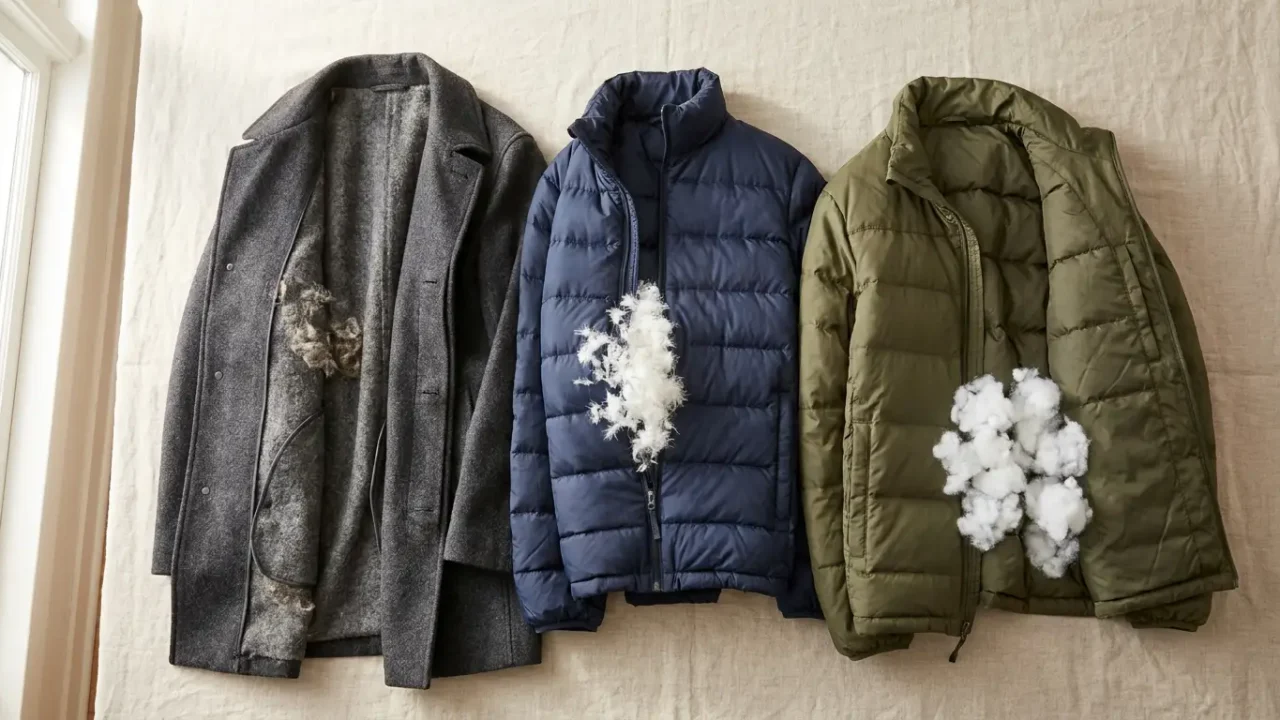
Standing in front of a wall of winter coats, the fill type listed on the tag rarely gets the attention it deserves. Most shoppers focus on color, cut, and price, but the fill inside a coat has more influence on how warm, heavy, and practical it actually is than almost any other factor. Wool, down, and synthetic insulation each solve the warmth problem differently, and the right choice depends less on which is “best” overall and more on which matches your climate, budget, and daily routine.
In this guide
- How Each Fill Actually Works
- Warmth for Weight
- Performance When Wet
- Durability and Lifespan
- Cost Comparison
- Ethical and Material Considerations
- Which Fill Fits Your Life
- Final Thoughts
How Each Fill Actually Works
Wool works through its natural fiber structure. Each strand has microscopic crimps and scales that trap small pockets of air, and wool also has a unique ability to absorb a fair amount of moisture (up to around a third of its weight) before it feels wet, which is part of why wool stays warm even in damp conditions where other materials would feel cold and clammy.
Down uses a completely different mechanism. The soft, fluffy clusters found under a bird’s feathers trap an enormous amount of air relative to their weight, which is why down has one of the best warmth-to-weight ratios of any insulation. The catch is that down’s insulating power comes entirely from loft, the fluffiness of the material, and loft collapses when down gets wet, which is why wet down loses most of its warmth until it dries out again.
Synthetic insulation is engineered to mimic down’s air-trapping structure using polyester fibers, often in a tightly packed batting rather than loose clusters. It doesn’t trap quite as much warmth per ounce as down, but the fiber itself doesn’t absorb water, so it keeps insulating reasonably well even when damp.
Warmth for Weight
If pure warmth-to-weight ratio is the priority, down usually wins. A down coat can deliver more warmth for less bulk than almost anything else, which is part of why down remains popular for extreme cold weather and for travelers who want warmth without a heavy suitcase.
Wool falls in the middle. It’s warm, but it’s also naturally denser and heavier than down for the same level of insulation, so a wool coat that matches a down coat’s warmth will usually weigh more and feel bulkier.
Synthetic insulation generally needs more material to match down’s warmth, which is why synthetic coats are often slightly bulkier than a similarly warm down coat. The gap has narrowed over the years as synthetic fiber technology has improved, but down still tends to edge ahead on pure warmth-to-weight performance.
Performance When Wet
This is where the three fills diverge the most. Wool’s ability to stay warm even when damp makes it a strong choice for climates with frequent rain, light snow, or high humidity, since it doesn’t lose its insulating properties as quickly as down does.
Down performs best in dry, cold climates where moisture isn’t a constant concern. In a wet climate, an uncoated down coat can become a liability, losing loft and warmth exactly when you need it most. Some down coats address this with a water-resistant outer shell or water-resistant treated down, which helps but doesn’t fully solve the problem in sustained rain.
Synthetic insulation holds up best in consistently damp or unpredictable weather. Because the fibers themselves don’t absorb water the way down does, a synthetic coat keeps working reasonably well even after getting wet, which is part of why synthetic fill is common in budget and performance jackets built for variable weather.
Durability and Lifespan
A well-made wool coat can genuinely last decades with proper care, which is part of why wool coats are often treated as long-term investment pieces rather than something replaced every few years. Wool resists pilling better than many synthetics and tends to hold its shape well over time.
Down coats can also last a long time, but the fill can gradually lose loft over years of compression and use, especially if not cared for properly (storing a down coat compressed for long periods reduces its lifespan). Occasional proper washing, following the care label, helps restore loft and extend the coat’s usable life.
Synthetic insulation tends to have a shorter practical lifespan than either wool or down, since the fibers can compress and lose loft more permanently over repeated use and washing. This isn’t necessarily a dealbreaker, since synthetic coats are often priced to match that shorter lifespan, but it’s worth factoring in if you’re comparing cost per year of use rather than just upfront price.
Cost Comparison
Synthetic insulation is generally the most budget-friendly option upfront, which makes it a practical choice for growing kids, occasional wear, or anyone not ready to invest in a higher-cost coat. Wool and down both tend to sit at a higher price point, with high-quality wool coats and high-fill-power down coats often costing significantly more than a comparable synthetic option.
That said, cost per year of wear tells a different story. A well-maintained wool coat worn for ten or more years can end up costing less annually than a cheaper synthetic coat replaced every two or three seasons. If budget allows, it’s worth weighing long-term cost alongside the upfront price tag.
Ethical and Material Considerations
Down is an animal byproduct, typically sourced from ducks or geese, and sourcing practices vary significantly between brands. Shoppers who prefer to avoid animal-derived materials, or who want assurance around humane sourcing, often look for certifications addressing animal welfare in the supply chain, or choose synthetic insulation instead, which avoids the issue entirely.
Wool is also an animal product, though the sourcing concerns are different from down, since wool is sheared rather than harvested from the animal directly. As with down, sourcing practices and welfare standards vary by producer.
Synthetic insulation sidesteps animal sourcing questions but comes with its own environmental considerations, since it’s typically petroleum-based and doesn’t biodegrade the way natural fibers do. Some brands now offer synthetic insulation made from recycled materials, which addresses part of that concern.
Which Fill Fits Your Life
If you live somewhere cold and dry, and want the lightest, warmest option available, down is hard to beat. If your climate brings regular rain, slush, or humidity, wool or synthetic insulation will serve you better than uncoated down. If budget is the deciding factor, or you need a coat for a child who’ll outgrow it in a year or two, synthetic insulation offers solid performance without a high price tag. And if you’re looking for a coat you’ll wear for a decade or more and want something that holds its shape and style over time, a well-made wool coat is often the better long-term investment.
Many people end up owning more than one fill type for different purposes, like a wool coat for daily city wear and a down or synthetic jacket for outdoor activities or travel. There’s no rule that says you need to pick just one.
Final Thoughts
Wool, down, and synthetic fill all solve the same basic problem, staying warm, but they do it in different ways with different trade-offs around weather resistance, weight, cost, and longevity. Matching the fill to your actual climate and how you’ll use the coat matters more than chasing whichever option sounds most premium. Once you’ve settled on a fill type, our guide on how to choose the right coat for your body type can help you narrow down the silhouette, and our coat care guide covers how to keep whichever fill you choose looking good for years. If you’re layering a coat over other pieces, how to layer coats in winter without looking bulky is worth a read too.
For more on how fill power is measured and what the numbers on a down coat’s tag actually mean, this overview of fill power is a useful reference, and the independent testing at OutdoorGearLab regularly compares real-world warmth and durability across wool, down, and synthetic jackets if you want to dig deeper into specific products.
New to coat materials in general? Our beginner’s guide to coat fabrics explains what wool, cashmere, tweed, and synthetics actually mean on a label.
Deciding between a puffer and a wool coat? See our comparison of puffer jacket vs wool coat.