“Waterproof” and “water-resistant” get used almost interchangeably in casual conversation, but on a jacket label they mean very different things. Buying based on the wrong assumption is how people end up soaked on a rainy commute despite owning a jacket that technically kept some water out. Knowing what these terms actually mean, and what the numbers on a tag represent, makes it much easier to buy a jacket that matches what you’ll actually use it for.
In this guide
- Water-Resistant: The Basic Level of Protection
- Waterproof: A Different Standard Entirely
- How Hydrostatic Head Ratings Work
- Breathability Is the Other Half of the Equation
- Matching the Rating to What You Actually Need
- Reading the Label Correctly
- Maintaining Waterproof Performance Over Time
- Final Thoughts
Water-Resistant: The Basic Level of Protection
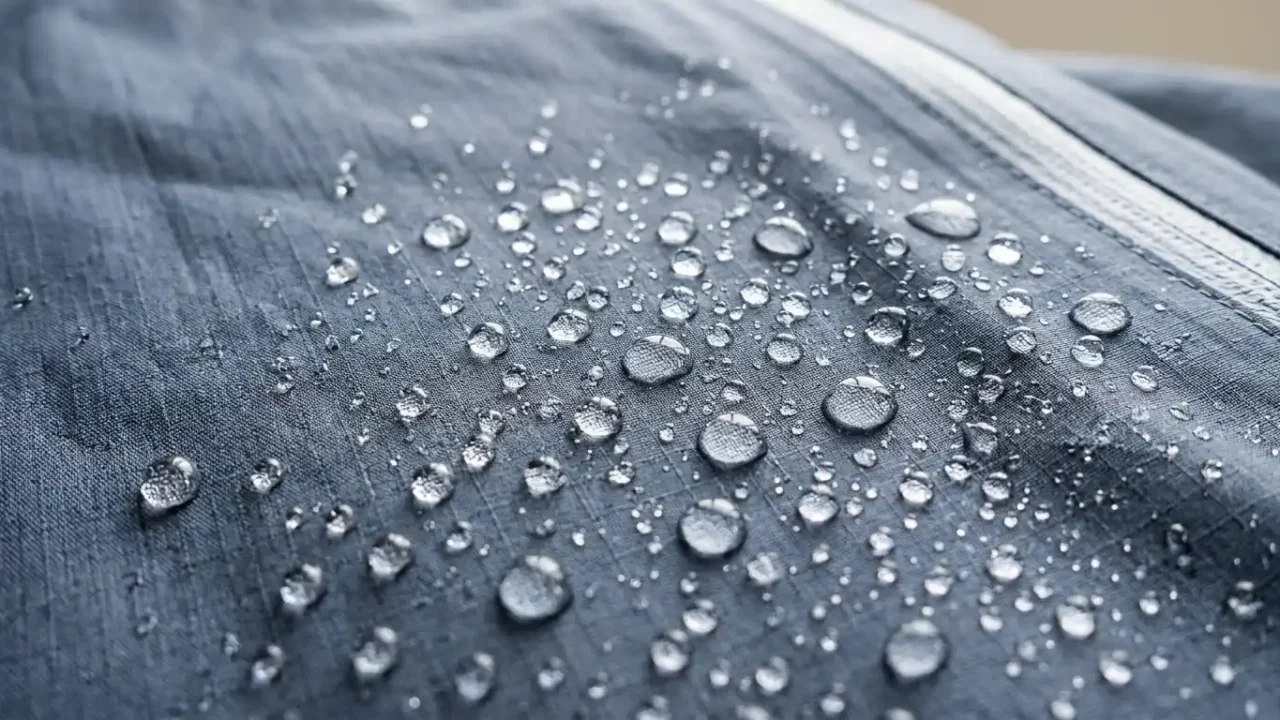
Water-resistant fabric has some natural or treated ability to repel light moisture, like a brief drizzle or a few stray raindrops, but it isn’t built to hold up against sustained rain. Many jackets achieve this with a Durable Water Repellent (DWR) coating, a thin treatment applied to the fabric’s surface that causes water to bead up and roll off rather than soak in.
The catch is that DWR coatings wear off over time with washing, abrasion, and general use, and once that happens, the fabric underneath may not offer much resistance on its own. A water-resistant jacket is a reasonable choice for someone who mostly deals with light, occasional moisture, think a short dash from a car to a building, rather than someone walking or standing in real rain for an extended period.
Waterproof: A Different Standard Entirely
A genuinely waterproof jacket uses a different construction, typically a laminated membrane (like the well-known Gore-Tex, but also many other proprietary versions) bonded to the fabric, combined with sealed or taped seams. This combination blocks water from passing through the fabric itself, not just the surface, which is why a waterproof jacket can handle sustained rain in a way a water-resistant one can’t.
Seam sealing matters more than people realize. Stitching creates small needle holes in the fabric, and without a sealed tape covering those seams, water can work its way through the stitching even if the fabric itself is fully waterproof. A jacket marketed as waterproof but without taped seams is really only waterproof in the sections without stitching, which defeats a lot of the purpose.
How Hydrostatic Head Ratings Work
Many technical jackets list a hydrostatic head number, usually written as something like 10,000mm or 20,000mm. This number comes from a lab test that measures how many millimeters of water a column of fabric can withstand before water begins to pass through. The higher the number, the more water pressure the fabric can resist.
As a rough guide, fabric rated around 5,000 to 10,000mm is generally considered good for light to moderate rain and everyday wear. Fabric rated 10,000 to 20,000mm handles heavier, sustained rain well and is common in dedicated rain jackets and outdoor gear. Ratings above 20,000mm are typically reserved for serious outdoor or mountaineering use, where sustained exposure to heavy rain or wet snow is expected.
It’s worth noting that a high hydrostatic head rating on its own doesn’t guarantee comfort, since a fabric can be extremely waterproof but trap moisture and sweat inside if it isn’t also breathable.
Breathability Is the Other Half of the Equation
A fully sealed, waterproof jacket that doesn’t breathe can leave you nearly as wet from the inside, condensation from body heat and sweat with nowhere to go, as a jacket that let rain in from the outside. Breathability is usually measured separately, often as a moisture vapor transmission rate (MVTR), and better jackets balance both waterproofing and breathability rather than maximizing one at the expense of the other.
This is part of why genuinely high-performance rain jackets tend to cost more than basic water-resistant options: the membrane technology that allows a fabric to block liquid water while still letting vapor escape is more complex to manufacture than a simple water-resistant coating.
Matching the Rating to What You Actually Need
Not everyone needs a 20,000mm rated jacket, and buying far more waterproofing than necessary usually just means paying more for performance you won’t use. For someone mostly dealing with city life, brief outdoor walks, waiting for a bus, running errands, a water-resistant jacket or a moderately rated waterproof jacket (5,000 to 10,000mm) is often plenty.
For regular outdoor activity in wetter climates, hiking, regular dog walks regardless of weather, commuting by bike, a jacket in the 10,000 to 20,000mm range with taped seams offers a meaningful step up in reliability. True mountaineering-grade jackets with the highest ratings are overkill for most everyday situations, though they’re the right call for genuinely extreme conditions.
Reading the Label Correctly
When shopping, it helps to look past the word “waterproof” on a hangtag and check for three things: whether seams are taped or sealed, whether a hydrostatic head number is listed (and roughly where it falls), and whether the product mentions a breathability rating alongside it. A jacket that lists all three, with reasonable numbers for its intended use, is a far more reliable purchase than one that simply says “waterproof” with no supporting detail.
If a jacket only mentions a DWR coating without a hydrostatic head number, it’s most likely water-resistant rather than truly waterproof, regardless of what the marketing copy implies.
Maintaining Waterproof Performance Over Time
Even a genuinely waterproof jacket loses some performance over time as the DWR coating on its outer layer wears down, which can make the fabric feel like it’s “wetting out” (absorbing water on the surface) even though the underlying membrane is still blocking water from passing through. Washing the jacket occasionally with a technical gear detergent, rather than regular laundry detergent, and reapplying a DWR treatment every so often helps maintain that outer-layer performance.
This maintenance step is often overlooked, but it’s the difference between a waterproof jacket that still performs well after a few years and one that starts to feel noticeably less effective.
Final Thoughts
Waterproof and water-resistant aren’t just marketing variations on the same idea, they describe genuinely different levels of protection, with waterproof requiring sealed seams and a true barrier membrane, while water-resistant relies on a surface treatment that only handles light moisture. Checking for a hydrostatic head number, sealed seams, and a breathability rating gives a much clearer picture than the word “waterproof” alone. Once you’ve found the right rating for your climate, our guide on choosing outerwear fabric for different climates covers how this fits into the bigger fabric picture, and packing outerwear for travel is worth a look if that jacket is headed on a trip with you.
For a deeper technical breakdown of how hydrostatic head testing works, this overview of hydrostatic head measurement covers the testing method in more detail than most product labels do.
If your jacket has stopped repelling water, you may be able to fix it. See how to waterproof your jacket at home.