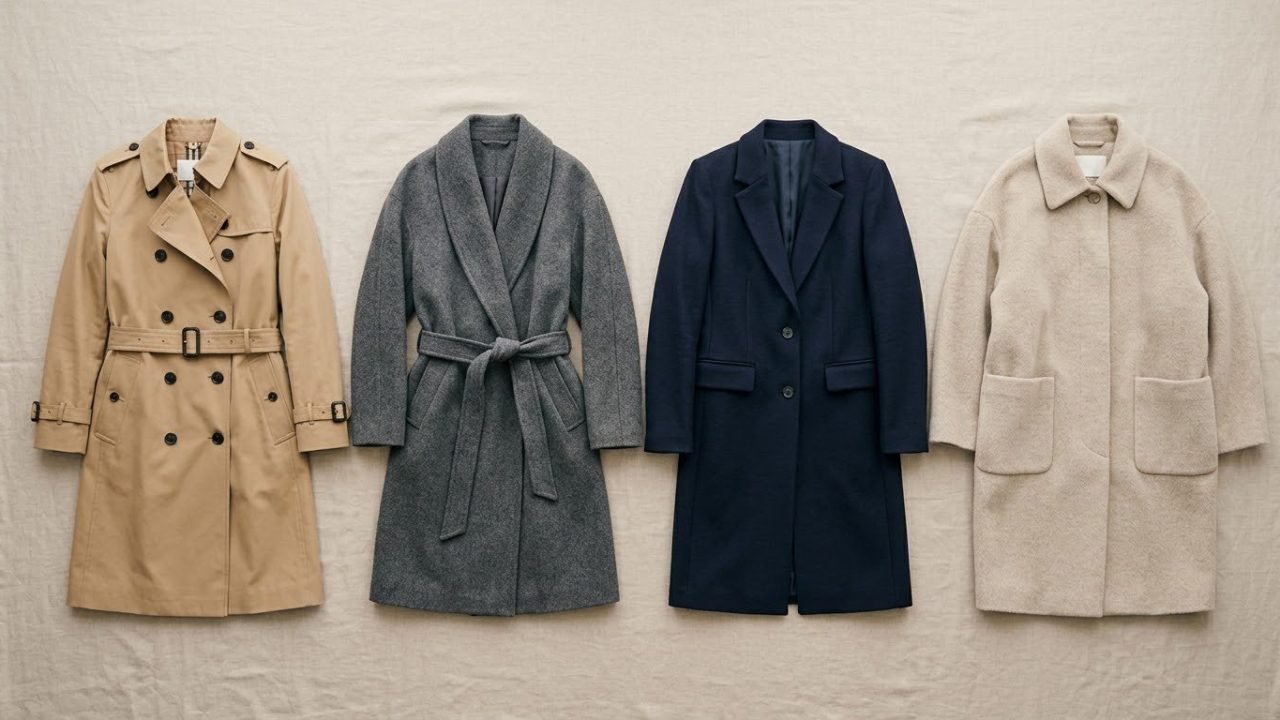
Coat shopping gets a lot easier once you stop asking “is this coat nice?” and start asking “does this coat work for my shape?” The same coat that looks sharp and balanced on one body can look shapeless or overwhelming on another, not because of quality, but because of proportion. The good news is that once you know your general body shape, picking a flattering coat becomes a matter of a few simple rules rather than trial and error on every shopping trip.
In this guide
- Why Coat Shape Matters More Than Trend
- Pear Shape (Fuller Hips, Narrower Shoulders)
- Apple Shape (Fuller Midsection, Slimmer Legs)
- Hourglass Shape (Defined Waist, Balanced Shoulders and Hips)
- Rectangle Shape (Balanced Shoulders and Hips, Less Defined Waist)
- Petite Frames
- Plus-Size Frames
- Universal Fit Checks, No Matter Your Shape
- Putting It Together
This guide breaks coat styling down by common body shapes, along with a few universal fit checks that matter no matter your shape.
Why Coat Shape Matters More Than Trend
A coat sits over everything else you’re wearing, so it has more influence over your overall silhouette than almost any other piece of clothing. A coat that’s cut wrong for your proportions can make an otherwise great outfit look bulky or shapeless, while a well-matched coat can make even a simple sweater-and-jeans combination look pulled together.
The goal isn’t to hide your shape. It’s to choose a coat structure that works with your natural proportions instead of fighting them, which usually comes down to where the coat gains or loses width, where it closes, and how long it falls.
Pear Shape (Fuller Hips, Narrower Shoulders)
For a pear shape, the goal is to bring a little visual width to the shoulders and keep the coat from adding bulk around the hips. Structured shoulders, even softly structured ones, help balance the proportions. A coat that falls just past the widest part of the hips, or alternatively one that goes long past the hips entirely (mid-calf or longer), tends to work better than one that cuts off right at the hip line, which can emphasize that area.
A-line or slightly flared coats are flattering here because they skim over the hips rather than clinging to them. Avoid coats with a lot of extra detail or pockets sitting right at hip level, since that draws the eye exactly where you’re trying to minimize attention.
Apple Shape (Fuller Midsection, Slimmer Legs)
For an apple shape, an open or slightly relaxed coat through the middle avoids clinging anywhere uncomfortable, while a defined shoulder line and a hem that hits above or well below the widest part of the midsection creates balance. Wrap coats work well, but only if worn a little looser rather than cinched tight, since a tight wrap can emphasize the midsection instead of skimming past it.
A single-breasted coat with a clean vertical line down the front tends to be more flattering than a double-breasted style, which adds visual width exactly through the center of the body. Coats that end around the knee also work well, since they draw attention down toward the legs, which are often slimmer on an apple shape.
Hourglass Shape (Defined Waist, Balanced Shoulders and Hips)
An hourglass shape generally has the most flexibility with coat styles, but the one detail worth prioritizing is waist definition. A belted coat, a wrap style, or any coat with a tailored waist seam highlights the natural waist-to-hip ratio instead of hiding it under a boxy shape.
Oversized or very structured boxy coats are the one style to be cautious with, since they can hide the waist completely and flatten out the natural shape. If you want an oversized look, belting it loosely at the waist keeps some definition while still getting that relaxed silhouette.
Rectangle Shape (Balanced Shoulders and Hips, Less Defined Waist)
For a rectangle shape, the opportunity is to create the appearance of more shape through the coat itself. A belted coat or a style with a nipped-in waist seam adds curve where the body is naturally straighter. Peplum details or a flared hem below the waist also introduce some shape without looking forced.
Double-breasted coats work particularly well on a rectangle shape, since the extra fabric and structure across the chest and waist area add dimension that a straighter body shape doesn’t naturally have. Avoid coats that are extremely straight-cut from shoulder to hem, since they can make the overall silhouette look even more one-dimensional.
Petite Frames
Regardless of body shape, petite height comes with its own set of proportion rules. A coat that’s too long relative to height can visually shorten the legs and overwhelm a smaller frame. Coats that hit mid-thigh to just above the knee usually work better than ones that fall past mid-calf, since a floor-skimming coat can swallow a shorter frame.
A defined waist also matters more on a petite frame, since an oversized, shapeless coat tends to add bulk without adding proportional height. Vertical lines, like a single row of buttons running top to bottom, create a lengthening effect that works in your favor.
Plus-Size Frames
For a plus-size frame, the most flattering coats tend to have structure through the shoulder and a defined, though not tight, waist. A coat that skims the body rather than clinging to it or hanging completely shapeless tends to be the most universally flattering choice. Mid-weight fabrics with some drape, rather than stiff or overly thick materials, move better and avoid adding unwanted bulk.
Vertical details, like a long row of buttons or a seam running from shoulder to hem, create a lengthening line that works well on a larger frame. A coat that ends at the widest part of the body (often right at the hip) can sometimes be less flattering than one that goes a few inches past it.
Universal Fit Checks, No Matter Your Shape
A few fit details matter regardless of body shape, and checking these first can save you from buying a coat that looks right on the hanger but wrong in person.
Shoulder seams should sit right at the edge of your natural shoulder, not drooping past it or pulling tight across it. This is one of the hardest things to alter later, so it’s worth prioritizing in the fitting room. Sleeve length should allow a little bit of your wrist or glove to show, rather than covering your whole hand or stopping short above the wrist.
Check how the coat fits when buttoned over what you’ll actually wear underneath, whether that’s a sweater or a blazer, since a coat that fits perfectly over a t-shirt can feel tight once a real winter layer goes underneath it. Sizing also varies from brand to brand. References like the ASTM D5585 body measurement tables give manufacturers a baseline for women’s sizing, but fit still differs between labels, so check each size chart before you order.
Once you’ve found a flattering shape, a couple of related guides can help you take it further. Our guide on coat care guide: how to keep your winter coat looking new is a good next read, and for background, see common body shape classifications.
Putting It Together
Choosing the right coat for your body type isn’t about finding one perfect style that works for everyone. It’s about understanding where your proportions naturally are and choosing a silhouette that complements rather than competes with them. Once you know your shape and the handful of style details that work in your favor, from waist definition to hem length to shoulder structure, coat shopping stops being guesswork and starts being a much faster, more confident process.
If you’re layering a coat over a sweater this season, our guide on how to layer coats in winter without looking bulky pairs well with these fit tips, since proportion matters just as much when you’re adding layers underneath. To see what’s current, check our guide to coat trends for 2026, and look at how to choose outerwear fabric for different climates before you buy.
Shape is only part of the equation — what the coat is filled with matters too. See our comparison of wool vs down vs synthetic coat fill to round out your decision.
Once you know your shape, learn how to spot a high-quality coat before you buy so the one you choose actually lasts.
Looking beyond long coats? See how to choose outerwear for different body types, covering puffers, parkas, vests, and shells.