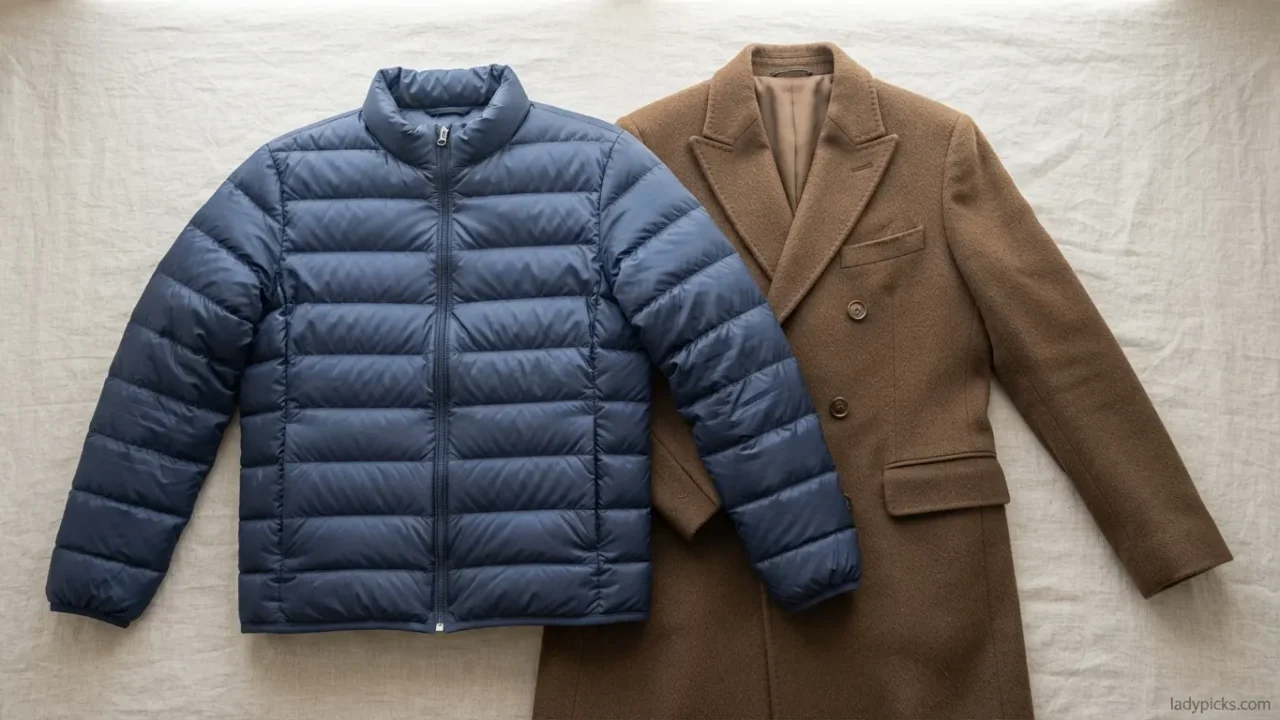
Few winter shopping questions come up as often as this one: should you buy a puffer or a wool coat? Both can keep you warm, both come in a huge range of prices, and both have loyal fans. But they work in very different ways, they suit different weather, and they look very different with the rest of your wardrobe. The right choice depends less on which one is “better” and more on how you actually spend your winter days. Here’s a practical comparison to help you decide.
In this guide
- How Each One Keeps You Warm
- Warmth for the Weight
- Weather: Wind, Rain, and Snow
- Style and Dress Code
- Comfort and Movement
- Durability and Lifespan
- Care and Cleaning
- Price and Value
- Who Should Buy Which?
- Final Thoughts
How Each One Keeps You Warm
A puffer jacket gets its warmth from insulation sealed into stitched sections, called baffles. The insulation, usually down or a synthetic fill, traps air, and trapped air is what holds heat close to your body. If you want to see how the construction works, this overview of the puffer jacket is a handy reference.
A wool coat works differently. Wool fibers are naturally crimped, which creates tiny pockets of air, and the fabric is woven densely enough to block a good amount of wind. It’s warm on its own, although a thick wool coat is usually heavier than a puffer of similar warmth. For a closer look at the insulation itself, our breakdown of wool vs down vs synthetic coat fill goes into the details.
Warmth for the Weight
If your priority is the most warmth with the least weight, a puffer usually wins. A well-made down puffer can feel almost weightless while still handling serious cold. A wool coat that’s equally warm tends to be noticeably heavier, which you may feel on your shoulders if you wear it all day.
That said, weight isn’t everything. Some people like the substantial feel of a wool coat, and the structure it gives to an outfit. If you’re walking short distances or commuting by car or train, the extra weight may not bother you at all.
Weather: Wind, Rain, and Snow
Weather is often where the decision gets made. Puffers typically have a smooth nylon or polyester shell, which sheds light rain and snow well and blocks wind. Many are treated with a water-repellent finish, though a puffer isn’t the same as a waterproof rain jacket, and down insulation loses warmth when it gets soaked.
Wool absorbs some moisture before it feels wet and handles light drizzle and dry snow reasonably well, but heavy, sustained rain will eventually soak through, and a wet wool coat is heavy and slow to dry. In a very wet climate, neither is ideal on its own, and a waterproof shell or a coat with a weather-resistant finish may serve you better. Our guide on choosing outerwear fabric for different climates can help you match materials to your weather.
Style and Dress Code
This is where the two differ most. A wool coat has a polished, classic look that works easily over office clothes, dresses, and smart-casual outfits. It suits workplaces, dinners, and anywhere you want to look put together.
A puffer reads as casual and sporty. It’s at home with jeans, sneakers, and weekend outfits, and it’s the practical choice for walking the dog, standing outside at a game, or getting through a cold commute. Some puffers are sleek enough to dress up a little, especially in longer cuts and neutral colors, but they rarely have the formality of a tailored wool coat.
Comfort and Movement
Puffers are soft and flexible, so they’re comfortable for driving, cycling, and active days. They also compress easily, which is useful if you need to stuff the coat into a bag.
Wool coats have more structure. A well-cut one moves nicely but can feel a bit restrictive over bulky layers, so it helps to try it on with the sweaters you actually wear. If you’re unsure about proportions and layering, our guide on building the perfect outerwear wardrobe explains how to leave enough room.
Durability and Lifespan
A good wool coat can last many years. Wool is a resilient fiber, and a well-made coat keeps its shape and often looks better with age, as long as it’s cared for properly.
Puffers can last a long time too, but the shell fabric can snag or tear, the stitching can wear at stress points, and insulation can flatten over time, especially if the jacket is stored compressed. A cheap puffer may only give you a few seasons, while a higher-quality one can last far longer. Our guide on how to spot a high-quality coat before you buy applies to both types.
Care and Cleaning
Puffers are often easier to look after day to day. Many can be spot cleaned or machine washed on a gentle cycle, following the label, then dried with care so the fill regains its loft. Wool coats usually need more attention: regular brushing, airing out, and occasional dry cleaning, though washing frequency should be kept low. Our coat care guide covers the everyday habits that keep either type in good shape.
Price and Value
Prices overlap heavily, so there’s no simple rule. Entry-level puffers tend to cost less than good wool coats, but top-end down puffers can be expensive, and affordable wool blends exist as well. It’s worth thinking in terms of cost per wear: a coat you reach for every day for several winters is a better value than a cheaper one you wear rarely or replace after two seasons.
Who Should Buy Which?
A puffer jacket suits you if you live somewhere very cold, spend a lot of time outdoors, want light and packable warmth, or need something casual and practical for everyday errands and commuting.
A wool coat suits you if you dress up for work or events, want a coat that looks polished with many outfits, prefer something you can keep for years, or live in a cold but fairly dry climate.
If you can’t decide, many people end up owning both: a wool coat for work and evenings, and a puffer for cold weekends, travel, and outdoor days.
Final Thoughts
There’s no single winner in the puffer vs wool debate. A puffer gives you the most warmth for the least weight and handles active, casual use. A wool coat gives you style, structure, and long-term durability. Think about your climate, your daily routine, and the clothes you wear underneath, and the right choice will usually be clear. Whichever you pick, try it on with your real winter layers before you buy.