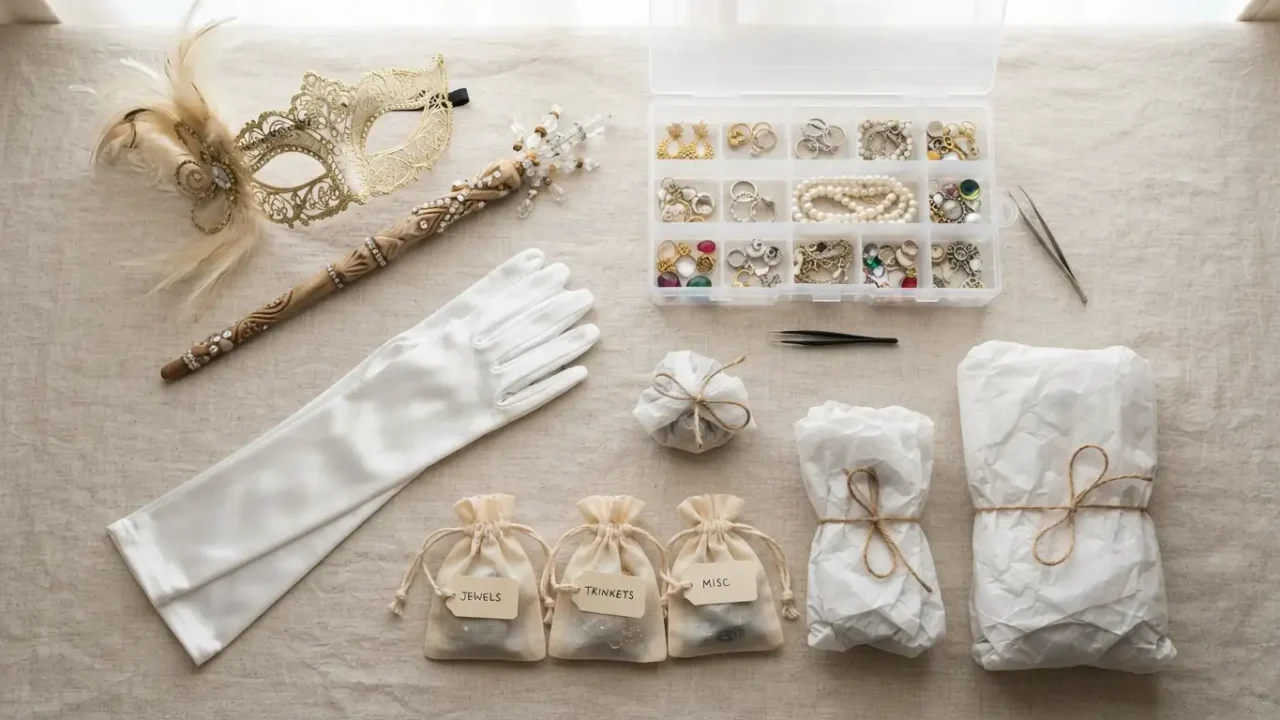
The costume itself usually survives the season just fine. It’s the small things that go missing or get wrecked: a bent wand, a crushed hat, a mask with a cracked nose, a tangle of necklaces that nobody can undo. Accessories are the pieces that make a costume work, and they’re also the easiest to damage in storage because they come in odd shapes and mixed materials. A little thought about how you pack them away saves a lot of frustration next year.
In this guide
- Sort Before You Store
- Clean Everything First
- Give Masks and Hats Support
- Handle Wigs Gently
- Keep Jewelry and Small Pieces From Tangling
- Store Props So They Don't Bend or Break
- Take Batteries Out of Light-Up Accessories
- Choose the Right Container
- Label and Keep a Simple Inventory
- Do a Mid-Year Check
- Make Good Use of What You Keep
- Final Thoughts
Sort Before You Store
Before anything goes into a box, sort your accessories into groups. Masks and hats in one pile, wigs in another, jewelry and small trinkets together, props like wands and swords separately, and anything electronic on its own. Sorting forces you to look at each item, which is the moment to throw out anything broken beyond repair and set aside what needs fixing.
Grouping like with like also makes storage easier, since each type of accessory has its own needs. A mask needs support so it keeps its shape, while jewelry needs to be kept from tangling.
Clean Everything First
Putting dirty accessories away is the easiest way to find them stained, sticky, or smelly next October. Wipe plastic and foam pieces with a damp cloth, let them dry completely, and brush any dust or glitter off hats and fabric items. Face paint and makeup residue on masks or headbands should come off before storage, since it attracts dust and can stain over time.
Make sure everything is fully dry before packing. Even a little leftover moisture can cause mildew or a musty smell in a closed container.
Give Masks and Hats Support
Masks and hats lose their shape when they’re squashed under other items. Stuff hats with crumpled acid-free tissue paper or a small towel so the crown keeps its form, and store them on top of a box rather than at the bottom. Masks can be nested with a little tissue padding between them, or stored upright in a box with dividers.
Wide-brimmed hats do best stored flat in a box with the brim supported, or hung on a hook by the inside band rather than the brim itself. If you’re short on space, a few rolled towels inside a box can create simple compartments that stop things from sliding around.
Handle Wigs Gently
Wigs tangle easily and flatten if stored carelessly. Brush a wig gently before storing it, then place it on a wig head or a rolled towel to keep its shape. If you don’t have a stand, a clean, sturdy container lined with tissue works well. Wrapping each wig loosely in a breathable cloth bag helps keep dust off without trapping moisture the way a sealed plastic bag can.
Keep Jewelry and Small Pieces From Tangling
Necklaces, bracelets, and small trinkets are the hardest accessories to keep track of. A divided box, such as a tackle box or a craft organizer with small compartments, gives each piece its own space. Chains can go into separate small pouches so they don’t knot together, and delicate pieces can be wrapped in a bit of tissue.
If you have small parts such as beads, buttons, or plastic gems, store them well out of reach of young children, since they can be a choking hazard. Our costume safety checklist covers the main points to watch for with small parts and batteries.
Store Props So They Don’t Bend or Break
Wands, swords, staffs, and other long props are best stored flat or standing upright, depending on what they’re made of. Foam and soft plastic props can bend permanently if they’re stored curved or under pressure, so a long, narrow box or a cardboard tube works well. Tie or tape them together in a bundle, and label the bundle so you know what’s inside.
Fragile prop details like painted decorations or glued-on elements should be wrapped separately, so they aren’t scraped by other items in the box.
Take Batteries Out of Light-Up Accessories
Light-up and electronic accessories deserve special care. Batteries left inside can leak over months of storage, damaging the circuitry and leaving corrosion that ruins the item. Remove the batteries before storing, and keep them in a separate, labeled bag, ideally somewhere out of reach of young children, since small button batteries are dangerous if swallowed.
Choose the Right Container
Clear, lidded plastic bins are a solid choice for most accessories, since they keep out dust and pests and let you see what’s inside. Cardboard boxes are fine for short-term storage, but they can attract pests and absorb moisture over a long time. For delicate items, wrapping them in acid-free tissue paper helps protect them from yellowing and staining.
If you store your accessories somewhere that can get damp, a small packet of silica gel in the container helps absorb excess moisture. Keep those packets away from children and pets, and avoid storing anything in places with big temperature swings, such as a hot attic or an uninsulated garage.
Label and Keep a Simple Inventory
A label on each container saves a lot of digging next year. Write what’s inside, which costume it belongs to, and the year you packed it. A quick photo of the contents on your phone makes a handy inventory, so you can check what you own without opening every box.
It’s also a good idea to keep each costume’s accessories together with the costume where possible. For a broader look at how to pack everything away, our guide to costume storage tips covers the costumes themselves.
Do a Mid-Year Check
It’s worth peeking into your storage once or twice during the year. Look for pests, dampness, or leaking batteries before they have time to do real damage. A quick check in spring or summer means you can fix problems early, rather than discovering them the week before Halloween.
Make Good Use of What You Keep
Well-stored accessories are also a great starting point for next year’s costumes. A stash of hats, scarves, and props can be mixed and matched into many different looks, and our list of DIY costume ideas using things you already own shows how far a small collection can go. If you’re using the same costume at several events in one season, our tips on making costumes last through multiple parties help keep everything in good shape in between.
Final Thoughts
Storing costume accessories well doesn’t take much more effort than tossing them in a bag, and the payoff is real: fewer broken props, fewer missing pieces, and a much easier time pulling a costume together next year. Clean everything, support the pieces that lose their shape, separate the small and fragile items, pull the batteries, and label your boxes. Do that once at the end of the season, and next year’s costume planning starts from a much better place.
If small children live in the house, see how to choose safe costume accessories for toddlers before deciding what to keep.
Sorting out what to keep first? Our guide on what to do with Halloween costumes after the holiday covers donating, swapping, and reselling.