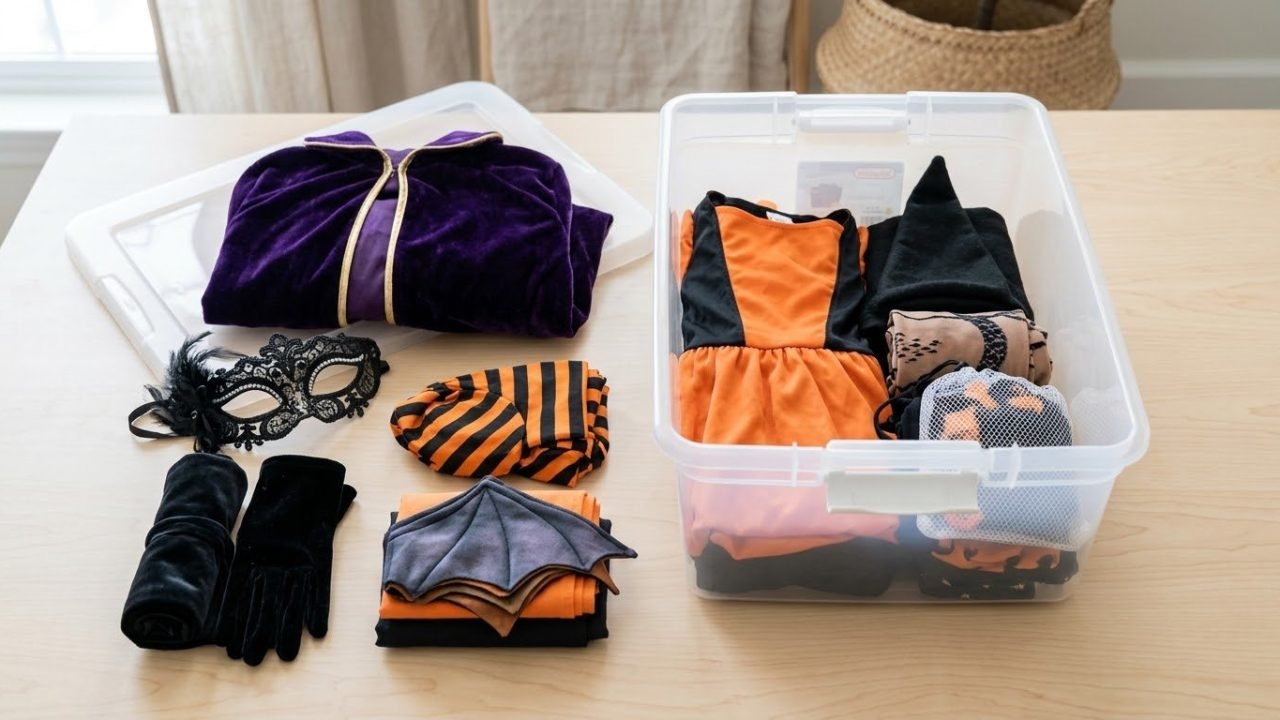
A good costume rarely gets worn more than once or twice a year, which means how it’s stored matters almost as much as how it’s made. A costume tossed into a drawer or left crumpled in a bag often comes out faded, wrinkled, or smelling musty by the next Halloween. A little care right after the holiday goes a long way toward getting several more years out of a costume your kids (or you) actually liked wearing.
In this guide
- Clean Before You Store, Every Time
- Repair Small Damage Right Away
- Fold or Hang, Depending on the Fabric
- Choose the Right Storage Container
- Keep Pests and Moisture Out
- Store Accessories Separately, But Together
- Label Everything Clearly
- Check In Partway Through the Year
- Final Thoughts
Here’s a practical walkthrough for storing costumes so they survive until next year, whether it’s a single cape or a growing collection of dress-up favorites.
Clean Before You Store, Every Time
The single biggest mistake in costume storage is putting something away dirty. Even if a costume looks fine, body oils, sweat, and small food or makeup stains can set into fabric over months of storage and become much harder (or impossible) to remove later. Stains that would wash out easily in October can be permanent by the following September.
Check the care label before washing anything. Many costumes are made from delicate or synthetic materials that need hand-washing or a gentle cycle rather than a standard hot wash. For costumes that can’t be washed at all, like some felt or foam pieces, a gentle wipe-down and a day of air drying is usually enough. Let everything dry completely before it goes into storage. Packing away anything even slightly damp invites mildew, which can ruin fabric and leave a smell that’s hard to get rid of.
Repair Small Damage Right Away
A loose button, a small tear, or a popped seam is an easy fix the week after Halloween, but it gets forgotten by the time the costume comes back out next year, and small damage tends to get worse while sitting in storage. Spend ten minutes doing basic repairs before you pack anything away. A needle and thread for seams, a hot glue gun for costume accessories, or iron-on patches for small tears are usually all it takes.
This step matters more than it seems. A costume that goes into storage already a little damaged often comes out unwearable, while the same costume repaired first can genuinely last for several more seasons.
Fold or Hang, Depending on the Fabric
Not every costume should be stored the same way. Structured pieces, like coats, capes, or anything with a stiff bodice, generally hold their shape better hanging up, since folding can create permanent creases in heavier fabric. A garment bag over a hanger keeps dust off and protects against light fading if it’s stored somewhere that gets any sun.
Lighter, stretchy, or soft fabric costumes are usually fine folded, as long as they’re folded loosely rather than crammed into a tight space. Tight folding over a long period can set in creases that are hard to steam or iron out later. If a costume has any stiff decorative elements, like a plastic emblem or an appliqué, fold around it rather than on top of it to avoid cracking or flattening the detail.
Choose the Right Storage Container
Cardboard boxes seem like the obvious choice, but they’re actually one of the worse options for long-term costume storage. Cardboard isn’t fully sealed, so it lets in dust, moisture, and pests, and it can also absorb moisture itself, which creates a musty smell over time.
Clear plastic storage bins with snap-on lids are the better choice. Being clear makes it easy to see what’s inside without digging through every box when next Halloween rolls around, and the sealed lid keeps out dust, bugs, and humidity far better than cardboard. For costumes you want to protect from any light exposure (some fabric dyes fade with UV exposure even indoors), a bin stored in a closet or under a bed works better than one on an open shelf.
For costumes you’re hanging rather than folding, a breathable garment bag is a good middle ground. Look for fabric or canvas garment bags rather than thick plastic ones, since plastic can trap moisture against the fabric over long periods. The Canadian Conservation Institute also lists guidance on caring for textiles and costumes, including hanging and rolled storage, if you want to go deeper.
Keep Pests and Moisture Out
Fabric-eating pests, like moths and silverfish, are drawn to natural fibers (wool, cotton, silk) more than synthetics, but any costume can pick up a musty smell if stored somewhere damp, like a garage or an uninsulated attic. A few cedar blocks or sachets in a storage bin are a natural way to deter pests without the strong chemical smell of mothballs, and they can be refreshed every season by lightly sanding the surface to release more scent.
If you’re storing costumes somewhere with humidity swings, a small silica gel packet (the kind that comes in shoe boxes or supplement bottles) tucked into a bin helps absorb excess moisture. Just be sure any packets are out of reach if small children will be handling the storage bins.
Store Accessories Separately, But Together
Small costume accessories, like wands, masks, jewelry, or hair pieces, are the easiest things to lose between Halloweens. A simple fix is using a labeled gallon-size bag or a small pouch for each costume’s accessories, then storing that bag inside the same bin as the costume itself. That way, when the bin comes out next year, the whole costume, including every small piece, is in one place rather than scattered across different drawers.
For costumes with multiple pieces worn by more than one child over the years, a printed label on the bin with the costume name and size at the time of storage saves a lot of guessing later.
Label Everything Clearly
A storage bin with a vague label like “Halloween stuff” usually turns into a dig-through-everything situation the next October. Labeling each bin by costume name, or at minimum by size and year, makes it much faster to find what you need when the season comes back around, especially if costumes are being handed down between siblings or kept for a few different size ranges.
If you store costumes across multiple bins, keeping a simple written or photo inventory (even just a note on your phone) of what’s in each bin saves time hunting through storage every year.
Check In Partway Through the Year
It’s worth doing a quick check on stored costumes sometime in the middle of the year, rather than waiting a full twelve months to open the bin again. A five-minute check for any musty smell, visible pests, or moisture lets you catch a problem early, while waiting until the week before Halloween to discover an issue leaves no time to fix it.
This is also a good moment to check whether sizes still fit, especially for kids’ costumes, so you’re not caught off guard discovering a favorite costume no longer fits the week it’s needed.
Good storage habits start with smart choices on costume day too. For background, see how clothes moths damage stored fabric.
Final Thoughts
None of these steps take very long, and most of the work happens in a single afternoon right after Halloween, when the costume is already out and top of mind. Cleaning first, repairing small damage, choosing the right container, and labeling clearly are the habits that make the real difference between a costume that lasts one season and one that gets worn for years. If you are still putting together next year’s look, our guide to styling a Halloween costume for kids on a budget has ideas that reuse what you already own.
If you’re already thinking about next year’s costume lineup, our guide on costume safety tips for kids is a good one to revisit before the pieces come back out of storage.
If you have more than one event on the calendar before the costume goes into storage, our guide on making a costume last through multiple parties covers the between-wear care that keeps it in good shape until then.
Small pieces need their own plan too. See our guide on how to store costume accessories so they do not get damaged for masks, wigs, props, and jewelry.
Not sure what to keep? See what to do with Halloween costumes after the holiday before you pack anything away.