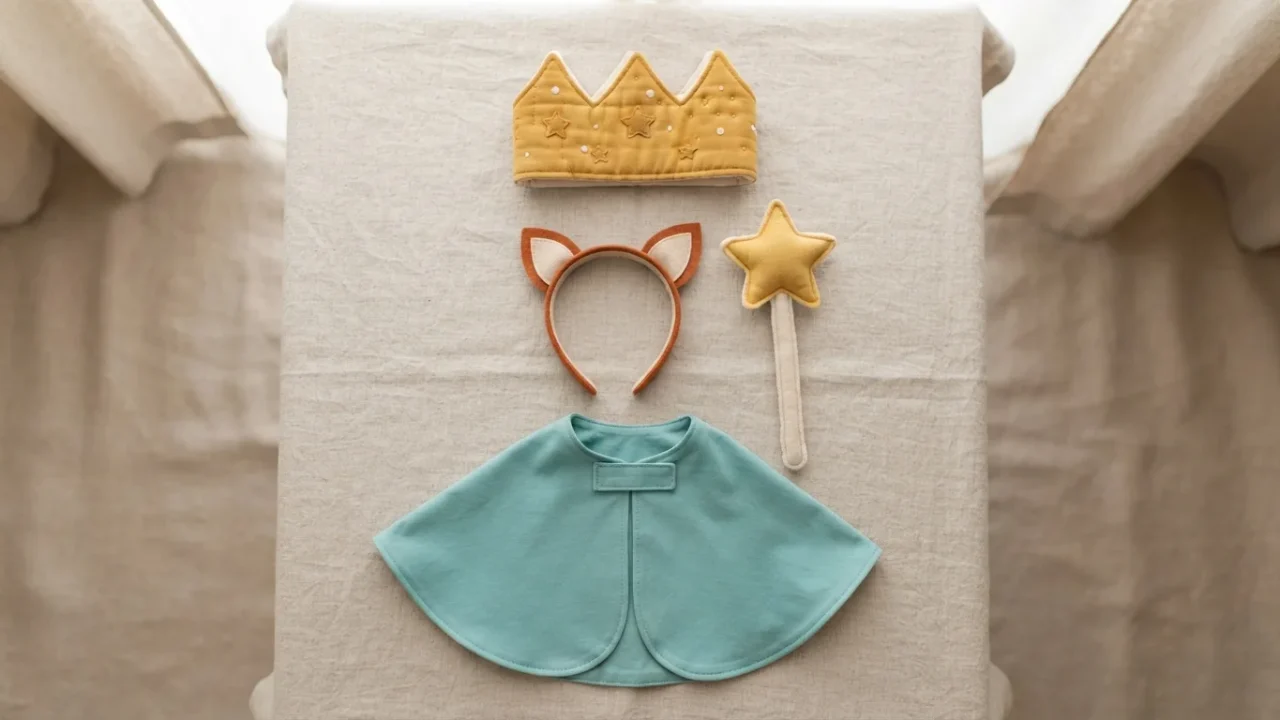
Toddlers in costumes are hard to resist, but they’re also a group that needs extra care. Children under three put things in their mouths, grab at anything within reach, and don’t yet understand why a long cord or a loose bead might be a problem. The costume itself is usually the easy part. It’s the accessories, the hats, wands, masks, and trinkets that come with it, that deserve a close look before a toddler wears them. A few simple checks can keep the fun in Halloween and the worry out of it.
In this guide
- Why Accessories Need Extra Attention
- Watch Out for Small Parts
- Check for Button Batteries
- Avoid Cords, Long Ties, and Strings
- Be Careful With Masks and Headwear
- Pick Soft, Lightweight Props
- Check Fabrics and Fit
- Make Sure Your Toddler Is Easy to See
- Do a Quick Pre-Trick-or-Treat Check
- Store Accessories Safely Afterwards
- Final Thoughts
Why Accessories Need Extra Attention
A costume made for toddlers is usually designed with their size in mind, but accessories are often an afterthought. Small decorations, loose trims, and cheap add-ons can come off easily, and a toddler can reach them and put them in their mouth within seconds. Because toddlers are also still learning to balance, anything that blocks their view or catches on their feet can lead to a fall.
It helps to think of safety in a few categories: choking, strangulation, vision, fire, and skin. If an accessory raises a concern in any of them, it’s better to skip it.
Watch Out for Small Parts
Choking is the biggest concern with toddler accessories. Buttons, beads, sequins, plastic gems, and glued-on decorations can all come loose. A common rule of thumb is that anything small enough to fit through a toilet paper tube is small enough to be a choking risk for a young child.
Before dressing a toddler, give each accessory a gentle tug and look for anything loose or poorly attached. Choose items with decorations that are stitched down securely, or better yet, accessories with printed or embroidered details instead of attached pieces. Balloons are another hazard for young children, so they’re best left out of any costume.
Check for Button Batteries
Light-up and sound-making accessories often run on small coin or button cell batteries, which can be very dangerous if swallowed. Look for battery compartments that are closed with a screw or a secure lock, rather than a simple snap-open lid. If you’re not sure whether an accessory contains a button battery, open the compartment on your own, check, and keep spare batteries well out of reach.
If a toddler might have swallowed a battery or any small object, treat it as an emergency and get medical help right away.
Avoid Cords, Long Ties, and Strings
Long cords, ribbons, and ties around the neck can be a strangulation risk. Capes, hoods, and masks that fasten at the neck should come apart easily and use soft Velcro or a snap rather than a knot or a stiff clasp. Skip accessories with long dangling strings, such as drawstring bags with cords that could loop around a neck, and avoid anything that hangs below the knee where it could catch underfoot.
Be Careful With Masks and Headwear
Masks are a poor fit for most toddlers. They can block vision and hearing, make breathing uncomfortable, and be frightening for the child wearing them. Face paint or a soft headband is usually a better choice. If you do use a hat or headpiece, make sure it’s lightweight and sits securely without sliding down over the eyes.
If you’re using face paint, test it first on a small patch of skin, and use only products made for use on skin. Our guide to costume makeup tips for sensitive skin explains how to patch test and remove makeup gently.
Pick Soft, Lightweight Props
If the costume includes a prop, choose one that is soft, lightweight, and rounded, such as a plush wand or a foam accessory, with no sharp tips or hard edges. Toddlers are prone to tripping and falling, and a rigid prop can cause injuries when they do. Keep props short enough that they won’t trip the child or poke anyone nearby.
Check Fabrics and Fit
Look for costumes and accessories made from soft, comfortable fabrics that won’t irritate skin. Check labels for flame resistance where available, and keep toddlers away from candles, lanterns, and other open flames regardless of the label. Make sure everything fits properly: hems should clear the ground, sleeves shouldn’t cover the hands completely, and nothing should restrict movement or breathing.
Comfortable shoes with good grip matter too. A costume that looks great but makes walking difficult can lead to falls on uneven sidewalks.
Make Sure Your Toddler Is Easy to See
Halloween often happens after dark, so visibility is part of safety. Light-colored costumes help, and reflective tape can be added to costumes and treat bags. Small, safe lights designed for children’s clothing can also help, as long as batteries are fully enclosed. Always hold a toddler’s hand or carry them near roads, and stay close at all times.
Do a Quick Pre-Trick-or-Treat Check
- Tug on every decoration to make sure nothing is loose.
- Confirm battery compartments are secured.
- Make sure nothing hangs around the neck or drags on the ground.
- Check that the child can see, breathe, and walk comfortably.
- Remove anything that seems fragile, sharp, or small.
For a broader list of things to check before heading out, our costume safety checklist for kids covers more of the essentials, including fit, fabric, and visibility. For general background on safety standards for children’s products, the U.S. Consumer Product Safety Commission is a useful reference.
Store Accessories Safely Afterwards
After Halloween, put small accessories and batteries away somewhere toddlers can’t reach, rather than leaving them in a toy box where a curious child can find them. Our guide on storing costume accessories without damage explains how to organize small pieces safely. If you’re keeping costs down, our tips on styling a Halloween costume for kids on a budget include ideas for simple, safe costumes.
Final Thoughts
Choosing safe costume accessories for a toddler comes down to a short list of habits: avoid small parts and button batteries, steer clear of cords and long ties, skip masks, and choose soft, lightweight props. Check everything before it goes on, stay close during the evening, and keep it simple. A well-chosen costume lets a toddler enjoy the night without any added risk.