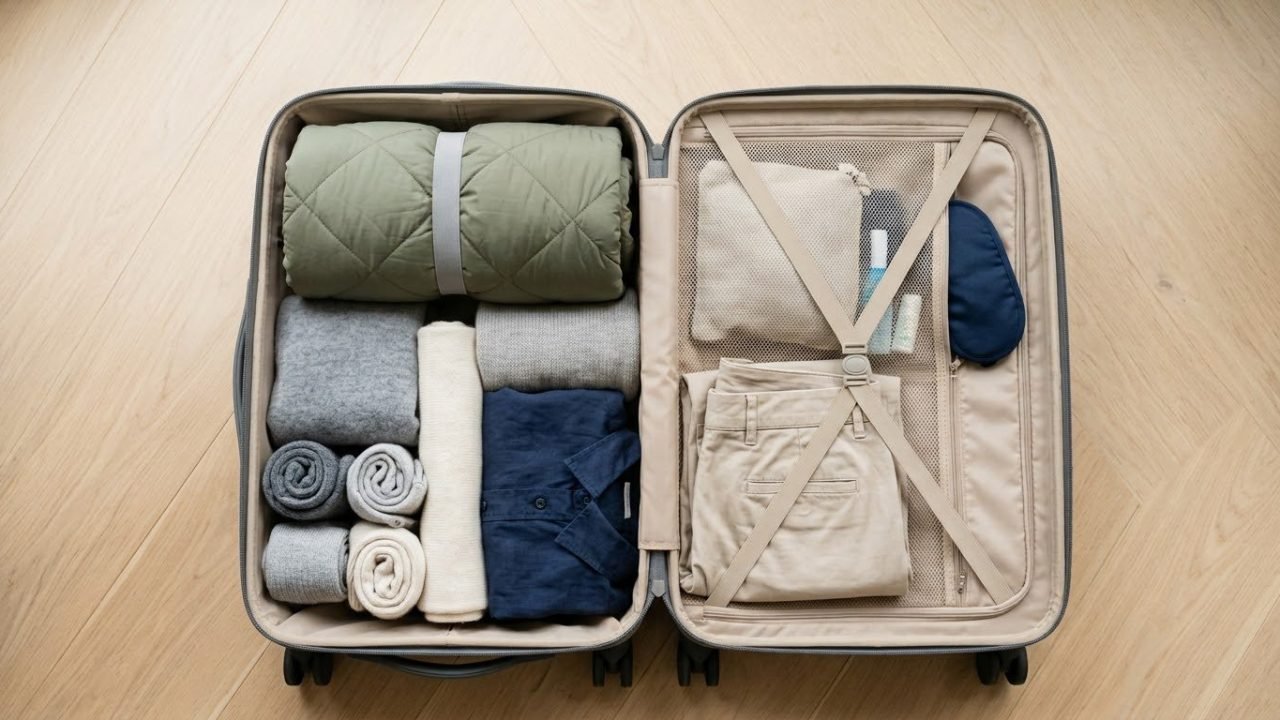
Outerwear is one of the hardest things to pack well. It’s bulky, it’s often the piece you care most about keeping presentable, and a bad packing job can leave a coat looking slept-in before you’ve even reached your destination. The good news is that a few packing techniques make a real difference, and most of them take no extra time once you know the method.
In this guide
- Start With the Fabric
- Roll, Don’t Fold, for Most Outerwear
- Use the Bundle Method for Structured Coats
- Pack Outerwear Last, On Top
- Consider Wearing It Instead
- Use a Garment Bag for the Pieces You Care About Most
- What to Do When You Arrive
- A Few Extra Packing Habits That Help
- Final Thoughts
Here’s how to get a coat or jacket from your closet to your destination without it coming out crumpled.
Start With the Fabric
Not all outerwear wrinkles the same way, so it helps to know what you’re working with before you pack. Structured wool coats and stiff shell jackets tend to hold creases longer and are harder to smooth out once wrinkled. Softer fabrics, like fleece, knit-backed jackets, or technical synthetic shells, bounce back more easily and tolerate rougher packing.
If you’re choosing between two coats for a trip, the one in a looser, more forgiving fabric will almost always travel better, even if the stiffer coat looks sharper on a hanger at home. Our guide to choosing outerwear fabric for different climates explains how common materials behave, which helps here too.
Roll, Don’t Fold, for Most Outerwear
Folding creates sharp crease lines exactly where the fold happens, and those lines are the hardest wrinkles to shake out. Rolling distributes the bend across a wider curve instead of a single sharp line, which is why it’s the go-to method for packing almost any jacket or coat.
To roll a coat well: lay it flat, button or zip it partway closed, fold the sleeves in so they lie flat against the body of the coat, then roll from the bottom hem up toward the collar. Keep the roll loose rather than tight. A very tight roll can actually create its own crease lines, especially in stiffer fabrics, so aim for a relaxed roll that lets the fabric curve naturally.
Use the Bundle Method for Structured Coats
For coats that wrinkle easily, like wool or tailored blazers, the bundle method works better than a simple roll. Lay the coat flat and place your softer clothing items (t-shirts, soft pants, anything that won’t wrinkle easily) in the center. Then fold the coat’s sleeves and sides in over that soft bundle, wrapping the coat around the other clothes like a package.
This technique uses the softer clothes inside as a cushion, so the coat bends in broad, soft curves rather than sharp folds. It takes a little more time to pack than simply rolling, but it’s the better option for a coat you want to look sharp the moment you arrive, like one you’re wearing to a meeting or an event right after travel.
Pack Outerwear Last, On Top
Regardless of rolling or bundling, outerwear should generally go in last, on top of everything else in the suitcase. Packing a coat underneath heavier items means it absorbs the weight and pressure of everything stacked on it for the entire trip, which sets in wrinkles far more than normal wear would.
If you’re using a packing cube system, keep the coat loose on top of the cubes rather than compressed inside one. Compression is great for soft clothing you don’t mind wrinkling, but it works against you with structured outerwear.
Consider Wearing It Instead
For bulky coats especially, wearing the coat through the airport rather than packing it is often the simplest fix. It saves suitcase space, avoids wrinkling altogether, and many coats are easier to carry on your body than to fit cleanly into luggage anyway. If your destination is warmer than where you’re departing from, you can always take the coat off once you’re through security and carry it or tie it around a bag for the rest of the trip.
This is especially worth considering for the bulkiest pieces, like a heavy wool coat or a thick puffer, which take up a disproportionate amount of suitcase space relative to how much they weigh.
Use a Garment Bag for the Pieces You Care About Most
If you’re traveling with a coat you really don’t want wrinkled, like one for a wedding or an important meeting, a garment bag is worth the extra step. A garment bag that folds in half fits in most roller bags and overhead compartments, and it keeps the coat largely flat rather than rolled or bundled.
For checked luggage, a garment bag still helps, since it keeps the coat separated from the friction and pressure of other items shifting around it during the flight.
What to Do When You Arrive
Even with careful packing, most coats pick up some wrinkles during travel. A few quick fixes once you’ve arrived can take care of most of it. Hanging the coat up as soon as you unpack lets gravity pull out a surprising number of light creases on its own, especially if you give it a few hours before you need to wear it.
For a faster fix, hanging the coat in a steamy bathroom while you shower works almost as well as a garment steamer. The steam relaxes the fibers enough for light wrinkles to drop out. For a fabric that can tolerate it (check the care label first), a handheld steamer or a warm iron on a low setting with a cloth barrier between the iron and the fabric handles deeper creases. If you are not sure what the symbols on the tag mean, the American Cleaning Institute has a guide to fabric care symbols, including the ironing and steaming ones.
Avoid ironing directly on wool, leather, or anything with a textured or technical finish, since direct heat can damage or flatten the texture permanently. When in doubt, steam is the safer option over direct ironing. Once you are home, our coat care guide covers cleaning and storage so the coat stays in shape between trips.
A Few Extra Packing Habits That Help
A couple of smaller habits make a noticeable difference over a full trip. Packing tissue paper or a thin plastic dry-cleaning bag between folds or rolls reduces friction between fabric layers, which is one of the main causes of set-in wrinkles. It’s a trick dry cleaners use for a reason, and it costs almost nothing to apply at home.
It also helps to avoid overpacking the suitcase itself. A coat crammed into a bag that’s already overstuffed takes on far more pressure and creasing than one with a little breathing room around it. If you’re tight on space, that’s often a sign to wear the coat instead of packing it, rather than forcing it into an already-full bag.
Packing the right fabric in the first place also makes wrinkling less of a problem. For background, see TSA's general travel packing guidance.
Final Thoughts
Packing outerwear well comes down to a few consistent habits: rolling or bundling instead of flat-folding, packing it last and on top, and giving it a little help (steam, a few hours on a hanger, or a garment bag) once you reach your destination. None of these steps add much time to packing, but they’re the difference between pulling out a coat that looks ready to wear and one that needs an hour of smoothing out before you can put it on.
If you’re also thinking about how to layer once you’ve landed somewhere cold, our guide on how to layer coats in winter without looking bulky pairs well with a trip where you’re packing more than one outerwear piece.
If your travel jacket is already showing its age, our guide on the signs it is time to replace your outerwear can help you decide whether to repair it or retire it before the next trip.